

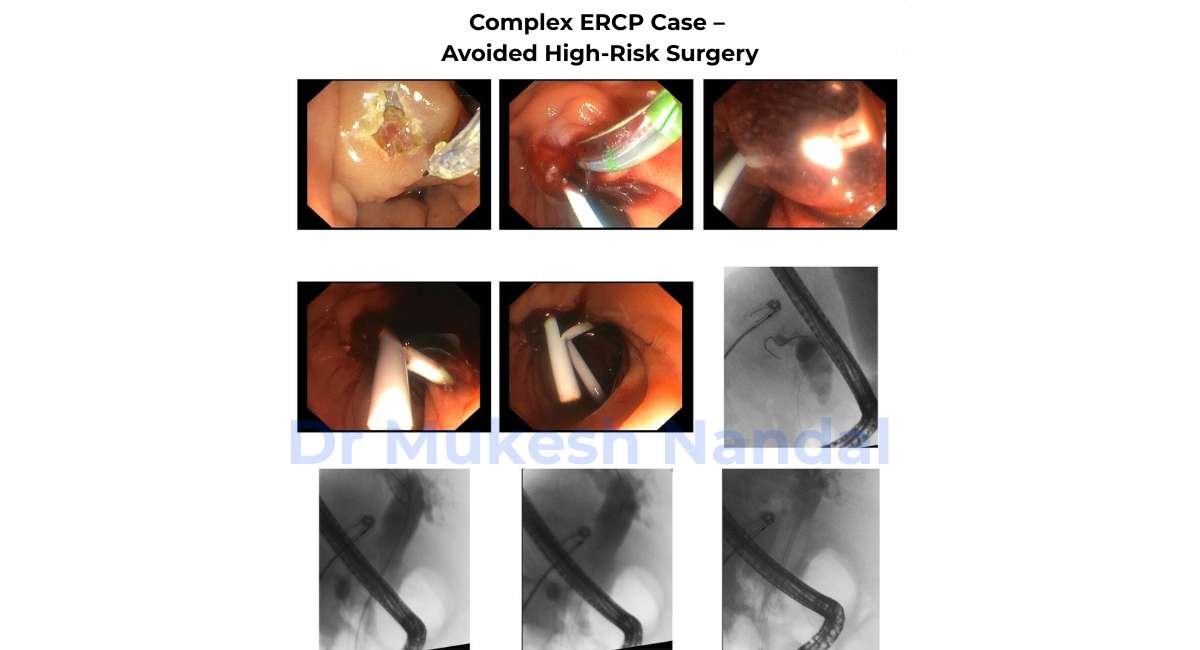
A Complex ERCP Case Successfully Managed Without High-Risk Surgery
In this ERCP case, a 53-year-old male patient presented with biliary obstruction requiring urgent intervention after experiencing persistent symptoms suggestive of blocked bile flow. Before reaching our center, the patient had already undergone multiple unsuccessful ERCP attempts at other hospitals, where difficult cannulation prevented successful biliary drainage.
Following repeated failed procedures, high-risk surgery had been advised elsewhere. However, because of previous family trauma related to similar surgery, the patient sought one final expert endoscopic opinion from Dr. Mukesh Nandal, Senior Consultant Gastroenterologist in Gurgaon.
Using advanced therapeutic ERCP techniques, successful duct access and drainage were achieved, helping the patient avoid immediate surgery.
Understanding Why This ERCP Case Was Clinically Challenging
ERCP (Endoscopic Retrograde Cholangiopancreatography) is an advanced endoscopic procedure used to diagnose and treat disorders of the bile duct, pancreatic duct, gallbladder, and surrounding structures.
This particular ERCP case became challenging because:
- Standard biliary cannulation had repeatedly failed
- The anatomy was technically difficult
- Prior attempts had increased procedural complexity
- Delayed drainage increased the risk of infection and worsening obstruction
In complex pancreatobiliary cases, each unsuccessful attempt can increase edema and make subsequent cannulation more difficult.
Clinical Presentation of This ERCP Case
The patient presented with symptoms commonly associated with biliary obstruction, including:
- Upper abdominal discomfort
- Jaundice
- Abnormal liver function tests
- Suspected obstructed bile duct requiring urgent decompression
Because obstruction was persistent, therapeutic intervention was necessary.
Why Previous ERCP Attempts May Have Failed
In many advanced biliary cases, failure happens because of:
- Difficult papillary access
- Distorted anatomy
- Tight distal obstruction
- Edematous papilla after repeated attempts
- Unstable guidewire positioning
This ERCP case had already undergone failed attempts at multiple advanced centers, making further intervention technically demanding.
Advanced Therapeutic ERCP Performed by Dr. Mukesh Nandal
At our center, the procedure was planned carefully with a focus on precision and minimizing risk.
During ERCP, the following was successfully achieved:
- Cannulation of the common bile duct (CBD)
- Cannulation of the pancreatic duct
- Placement of pancreatic stent
- Placement of biliary stent
- Effective internal drainage
These steps restored bile flow and relieved obstruction.
Why Pancreatic and Biliary Stenting Was Important in This ERCP Case
In difficult ERCP procedures, placing both stents can help:
- Protect the pancreas from post-ERCP pancreatitis
- Maintain ductal patency
- Improve drainage
- Reduce inflammation
- Stabilize the patient without emergency surgery
This dual stenting strategy is often critical in advanced therapeutic ERCP.
Outcome of the Procedure
The patient responded well after the procedure:
- Biliary drainage improved
- Symptoms stabilized
- No immediate complications developed
- Surgery was avoided at present
- Patient was discharged in stable condition
This highlights how expert endoscopic intervention can change outcomes even in highly complex cases.
When a Failed ERCP Still Deserves Another Expert Attempt
A failed ERCP does not always mean surgery is the only option.
Selected patients may still benefit when managed by an experienced therapeutic gastroenterologist with advanced expertise in:
- Difficult cannulation
- Guidewire-assisted access
- Double guidewire techniques
- Pancreatic stenting
- Complex biliary drainage
This ERCP case demonstrates that proper expertise can significantly alter treatment pathways.
Who Should Seek Expert Evaluation for Complex ERCP Cases?
Patients should seek advanced gastroenterology consultation if they have:
- Failed ERCP
- Recurrent jaundice
- CBD obstruction
- Difficult bile duct stones
- Benign or malignant strictures
- Pancreaticobiliary obstruction
Early referral can prevent unnecessary surgery in selected cases.
Why Experience Matters in Advanced ERCP
ERCP is one of the most technically demanding procedures in gastroenterology.
Success depends on:
- Operator expertise
- High-quality accessories
- Correct case selection
- Ability to manage complications immediately
Complex cases require advanced decision-making beyond standard endoscopy.
Expert Gastroenterology Care in Gurgaon
Dr. Mukesh Nandal manages complex pancreatobiliary disorders including:
- Difficult ERCP
- Biliary obstruction
- CBD stones
- Pancreatic duct disorders
- Obstructive jaundice
- Therapeutic endoscopy
At Atharva Gastro Clinic, Sector 10A Gurgaon / Naryana Hospital, Gurgaon, advanced gastrointestinal procedures are performed with patient-focused decision-making and evidence-based care.
Clinical Message
This ERCP case is a strong example that even after repeated failed attempts and surgical advice, carefully selected patients may still benefit from advanced endoscopic intervention in expert hands.
Early specialist evaluation can often help avoid major surgery and improve outcomes.