

Mirizzi Syndrome with a Large Bile Duct Stone and Broken Lithotripsy Basket: A Case Report
Medically reviewed by: Dr. Mukesh Nandal, MBBS; MD (Internal Medicine); DNB (Gastroenterology)
Quick answer
Mirizzi syndrome is a complication of gallstones in which a stone stuck in the neck of the gallbladder or the cystic duct presses on the main bile duct and causes jaundice. It is uncommon and can be difficult to treat.
In this case, a patient with Mirizzi syndrome had undergone ERCP two months earlier but had not had gallbladder surgery. A stone about 2 cm in size then slipped into a narrow common bile duct (CBD) and caused obstructive jaundice. During removal, the mechanical lithotripsy basket broke inside the duct. After about three hours, the team removed both the stone and the broken basket endoscopically, and the patient avoided emergency surgery.
Key points
- Mirizzi syndrome usually needs gallbladder surgery once the bile duct is cleared.
- When gallbladder surgery is delayed after ERCP, stones can move into the bile duct again.
- Large stones in a narrow bile duct often need crushing (lithotripsy) before they can be removed.
- A broken or stuck lithotripsy basket is a rare complication that may need surgery, laser lithotripsy or other advanced endoscopic techniques.
The case: a stone, a narrow duct and a broken basket
The patient had Mirizzi syndrome with obstructive jaundice. Details that could identify the patient have been left out.
- First ERCP, two months earlier. ERCP (endoscopic retrograde cholangiopancreatography) was done to relieve the bile duct blockage. Gallbladder removal was advised but was not carried out.
- The stone moved. With the gallbladder still in place, a stone of about 2 cm slid into the common bile duct, which was narrow. Jaundice returned.
- Mechanical lithotripsy. At repeat ERCP, the stone was captured in a lithotripsy basket so it could be crushed into smaller pieces. The large stone and narrow duct left little room to work.
- The basket broke. During crushing, the basket broke inside the bile duct, leaving both the stone and the basket stuck.
- Two options remained. Open or laparoscopic surgery to remove the stone and basket, or laser lithotripsy to break the stone from inside the duct.
- Endoscopic removal. After about three hours of continued endoscopic work, with anaesthesia support, the team removed both the stone and the broken basket without surgery.
Images from the procedure
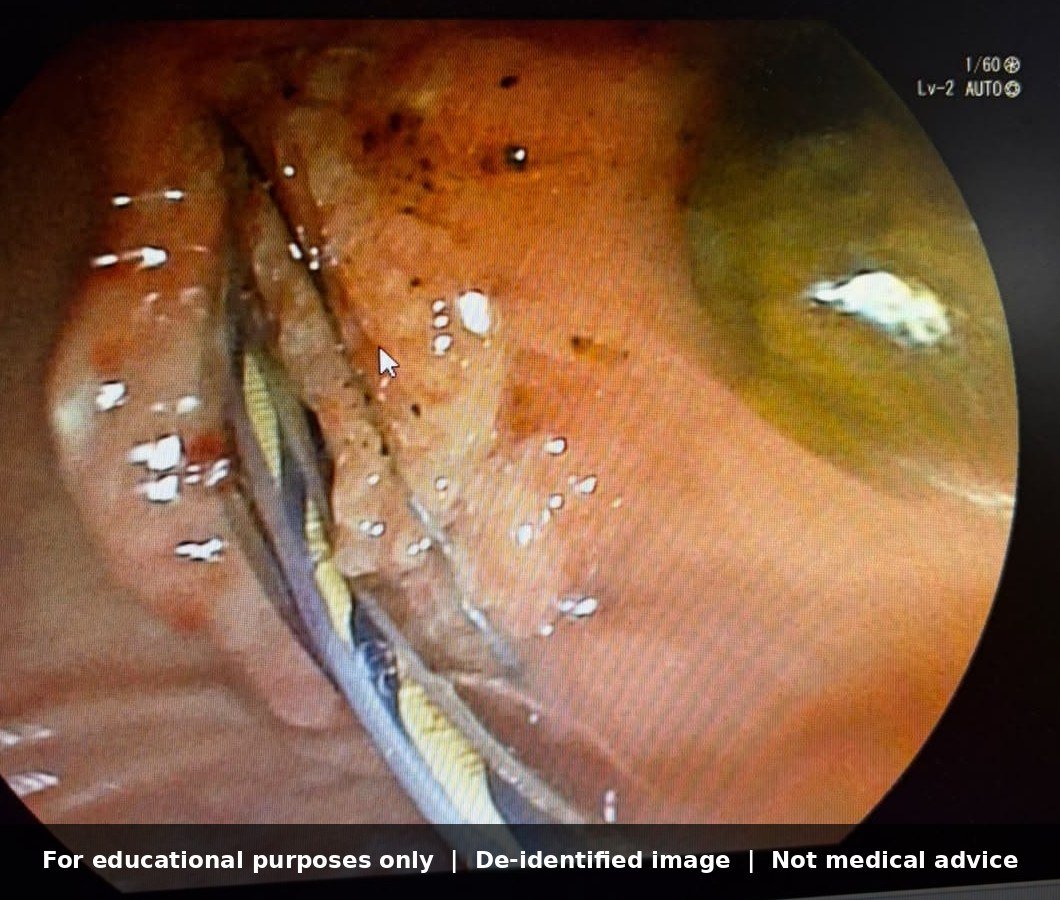
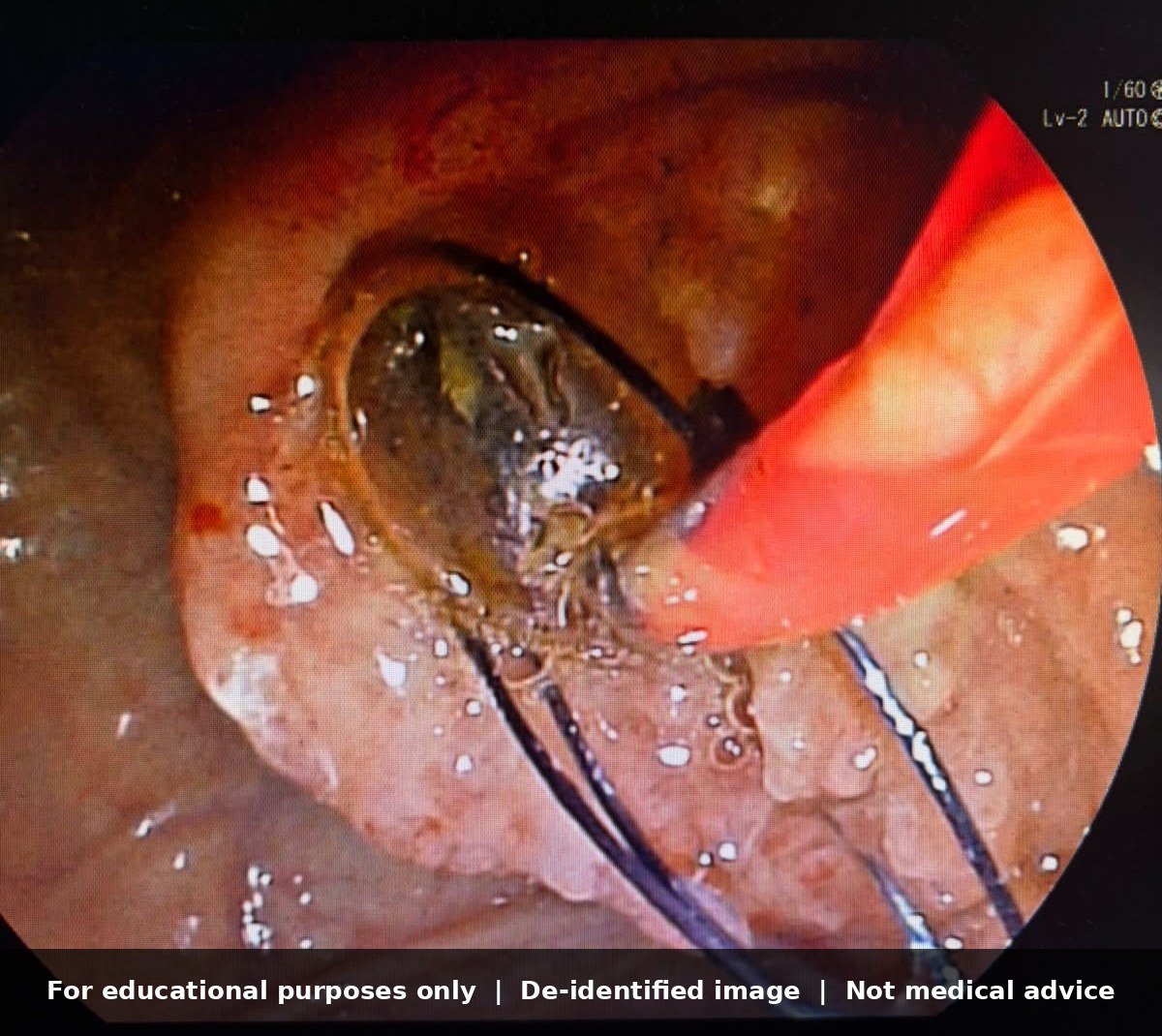
Image disclaimer: Images in this article are shared for educational and awareness purposes only. They are de-identified and are not a substitute for individual medical diagnosis or advice.
What is Mirizzi syndrome?
Mirizzi syndrome occurs when a gallstone impacted in the gallbladder neck or cystic duct presses on, or erodes into, the common hepatic duct. Bile flow is blocked and jaundice develops. It is found in a small proportion of people having gallbladder surgery and is often recognised only on imaging or during ERCP.
Common symptoms: yellowing of the eyes and skin, upper-right abdominal pain, fever, dark urine and pale stools.
Types (Csendes classification)
| Type | What it means |
|---|---|
| I | Stone presses on the bile duct from outside, no fistula |
| II | Fistula between gallbladder and bile duct, up to one-third of the duct wall |
| III | Fistula involving up to two-thirds of the duct wall |
| IV | Fistula with destruction of the whole duct wall |
| V | Any of the above plus a fistula between gallbladder and bowel |
The type guides the operation needed later, which is why imaging and ERCP findings matter.
Why large bile duct stones are difficult to remove
Most bile duct stones are removed at ERCP with a balloon or basket after the bile duct opening is widened. Stones larger than about 1.5 cm, stones larger than the duct below them, and stones in a narrowed duct are called difficult stones. They usually have to be broken into pieces first.
| Method | How it works | Notes |
|---|---|---|
| Large-balloon dilation | Stretches the bile duct opening so bigger stones can pass | Not suitable when the duct is narrow |
| Mechanical lithotripsy | A strong wire basket traps the stone and crushes it | Widely available; the basket can rarely break or get stuck |
| Laser or electrohydraulic lithotripsy | A thin camera (cholangioscope) in the duct guides energy to shatter the stone | Useful when other methods fail; needs special equipment |
| Surgery | Stone removed during an operation | Used when endoscopic methods fail or with gallbladder surgery |
What happens if a lithotripsy basket breaks?
Basket breakage or impaction is a recognised but uncommon complication of mechanical lithotripsy. The stone and basket can stay stuck in the bile duct. Options include rescue endoscopic techniques, laser or electrohydraulic lithotripsy to break the stone and free the basket, or surgery. The choice depends on the stone, the duct and the patient’s condition.
Why gallbladder surgery after ERCP matters
ERCP clears the bile duct, but it does not remove the gallbladder, where the stones form. While the gallbladder stays in place, stones can move into the bile duct again and cause jaundice, cholangitis (bile duct infection) or pancreatitis.
Guidelines therefore advise gallbladder removal (cholecystectomy) after bile duct stones are cleared, in patients fit for surgery, ideally during the same hospital admission or soon after. In Mirizzi syndrome, surgery is also needed to deal with the impacted stone and any fistula.
This case shows what can happen when surgery is delayed: a second, larger and more complex procedure was needed.
Frequently asked questions
What is Mirizzi syndrome?
It is a gallstone complication in which a stone stuck in the gallbladder neck or cystic duct compresses the main bile duct and causes jaundice.
Is Mirizzi syndrome serious?
It can be. It causes jaundice and may lead to infection or a fistula between the gallbladder and bile duct. It usually needs ERCP and surgery.
How are large bile duct stones removed?
Usually at ERCP, by crushing them with mechanical lithotripsy or breaking them with laser or electrohydraulic lithotripsy, then removing the fragments. Surgery is used when these fail.
What happens if the lithotripsy basket breaks?
The stone and basket can stay stuck in the duct. They may be removed with rescue endoscopic techniques, laser lithotripsy or surgery.
Why should the gallbladder be removed after ERCP?
Because stones form in the gallbladder. If it is left in place, stones can enter the bile duct again and cause jaundice, infection or pancreatitis.
Can a stone come back after ERCP?
Yes. Recurrence is more likely if the gallbladder is not removed or if the bile duct is narrowed or widened.
Acknowledgement
This was a long and demanding procedure, and it was completed through teamwork. Thanks are due to Dr. Raghu and the anaesthesia team, who kept the patient safe through the three-hour procedure, and to all the nurses, technicians and colleagues in the endoscopy unit.
About the author
Dr. Mukesh Nandal, MBBS; MD (Internal Medicine); DNB (Gastroenterology). Senior Consultant, Atharva Clinic, Sector 10A, Gurgaon.
References
- Csendes A, et al. Mirizzi syndrome and cholecystobiliary fistula: a unifying classification. Br J Surg. 1989;76:1139–1143.
- Manes G, et al. Endoscopic management of common bile duct stones: European Society of Gastrointestinal Endoscopy (ESGE) guideline. Endoscopy. 2019;51:472–491.
- Buxbaum JL, et al. ASGE guideline on the management of cholangitis and choledocholithiasis. Gastrointest Endosc. 2019;89:1075–1105.
Disclaimer
This article is for educational and awareness purposes only. It describes a single de-identified case and general information about Mirizzi syndrome and bile duct stones. It is not medical advice and does not replace consultation with a qualified doctor. Treatment choices depend on each patient’s condition and are made by the treating team. All images are shared with patient consent, are de-identified, and are for educational and awareness purposes only. Outcomes vary between individuals.