
EUS-Guided Gallbladder Drainage for Impending Gallbladder Perforation: A Case Report
Medically reviewed by: Dr. Mukesh Nandal, MBBS; MD (Internal Medicine); DNB (Gastroenterology)
Quick answer
EUS-guided gallbladder drainage (EUS-GBD) is an endoscopic procedure that drains an infected or obstructed gallbladder from inside the body. Using endoscopic ultrasound, a stent is placed between the gallbladder and the stomach or duodenum, so pus and bile drain internally. There is no skin puncture and no external tube or drainage bag.
In the case described here, a patient’s gallbladder was severely inflamed and at risk of perforation (rupture). EUS-GBD drained it internally and avoided a percutaneous cholecystostomy tube, which would have meant living with an external catheter and bag for weeks.
Key points
- EUS-GBD is used mainly for people with acute cholecystitis who are not fit for immediate gallbladder surgery.
- It is an alternative to percutaneous transhepatic gallbladder drainage (PTGBD), also called a cholecystostomy or PCD tube.
- International guidelines (Tokyo Guidelines 2018, ESGE 2022) recognise it as an option in experienced centres.
- It needs advanced therapeutic endoscopy skills and is not suitable for every patient.
The case: a gallbladder at risk of rupture
A male patient presented with a severely inflamed, distended gallbladder that showed signs of impending perforation. Details that could identify him have been left out.
A gallbladder close to perforation is a medical emergency. If it ruptures, bile and infected material can leak into the abdomen and cause peritonitis, abscess or sepsis. The gallbladder therefore needed urgent decompression.
The usual non-surgical route in this situation is a percutaneous cholecystostomy: a radiologist passes a tube through the skin and liver into the gallbladder. It works, but the patient then lives with an external catheter and drainage bag, often for several weeks. The tube can slip, block, leak or cause pain, and needs regular care.
The treating team chose EUS-guided gallbladder drainage instead. The aim was to decompress the gallbladder fully while sparing the patient an external tube.
How EUS-guided gallbladder drainage was done
EUS-GBD creates a small internal channel between the gallbladder and the stomach or duodenum, held open by a stent. It is done under sedation or anaesthesia, through the mouth, with no skin incision.
- Locate the gallbladder with endoscopic ultrasound. An echoendoscope, which has an ultrasound probe at its tip, is passed into the stomach or duodenum. The gallbladder lies right next to this wall and is seen clearly on ultrasound.
- Choose a safe window. Colour Doppler is used to avoid blood vessels between the gut wall and the gallbladder.
- Puncture and guide. Under real-time ultrasound, the gallbladder is entered through the gut wall, often with a needle and guidewire.
- Place the stent. A stent, commonly a lumen-apposing metal stent (LAMS), is deployed. Its wide flanges hold the gallbladder wall against the gut wall.
- Confirm drainage. Bile, pus and sludge are seen draining into the gut through the stent opening.
Image 1: Endoscopic ultrasound view of the gallbladder
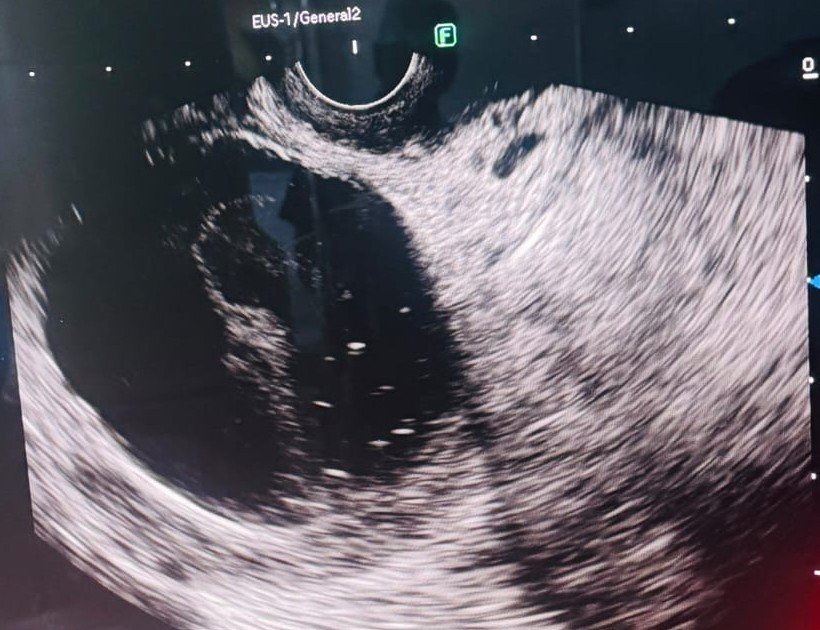
Image disclaimer: This image is shared for educational and awareness purposes only. It is de-identified and is not a substitute for individual medical diagnosis or advice.
Image 2: The endoscopy team during the procedure
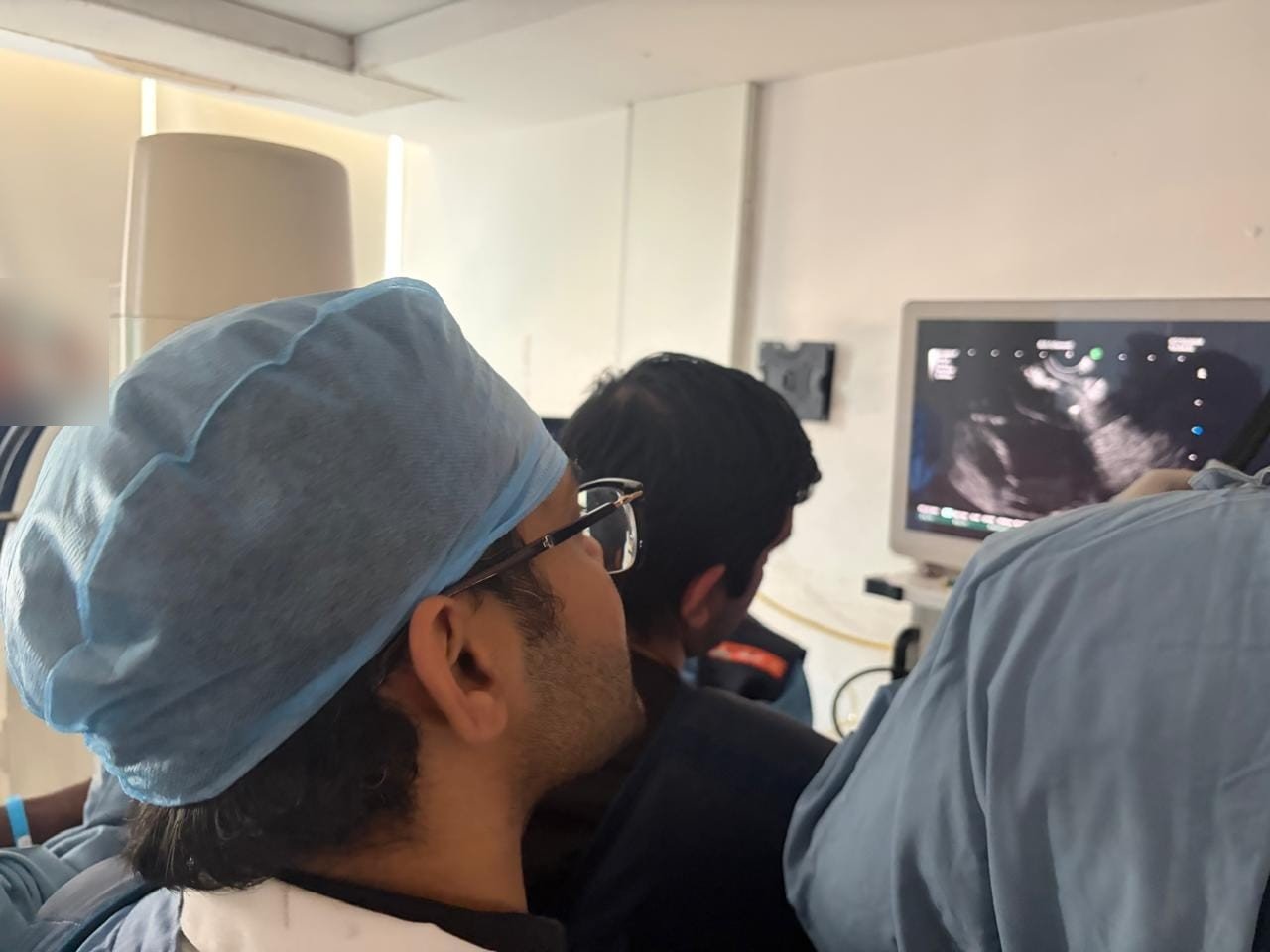
Image disclaimer: This image is shared for educational and awareness purposes only. It is not a substitute for individual medical diagnosis or advice.
EUS-GBD vs cholecystostomy tube vs surgery
Gallbladder removal (cholecystectomy) remains the definitive treatment for acute cholecystitis in patients fit for surgery. When surgery is too risky or must be delayed, drainage is the bridge, and EUS-GBD and a percutaneous tube are the two main options.
| Feature | EUS-guided gallbladder drainage | Percutaneous cholecystostomy (PCD tube) | Cholecystectomy (surgery) |
|---|---|---|---|
| Route | Through the mouth, stent from gut into gallbladder | Through the skin and liver into gallbladder | Laparoscopic or open removal of gallbladder |
| External tube or bag | None | Yes, usually for weeks | Sometimes a temporary surgical drain |
| Main role | High-risk or unfit-for-surgery patients | High-risk patients, widely available | Definitive treatment in fit patients |
| Common concerns | Stent migration, bleeding, leak, needs expert centre | Tube dislodgement, pain, leak, recurrent cholecystitis after removal | Anaesthesia and surgical risks in frail patients |
| Expertise needed | Advanced therapeutic endoscopy | Interventional radiology | General or laparoscopic surgery |
A randomised trial from Hong Kong (Teoh et al., Endoscopy, 2020) compared EUS-GBD with percutaneous drainage in very high-risk patients. It reported fewer adverse events, reinterventions and readmissions over one year with EUS-GBD.
Who may be considered, risks and recovery
EUS-GBD may be considered for:
- Acute cholecystitis in elderly or frail patients, or those with serious heart, lung or kidney disease
- Patients in whom surgery must be delayed
- A gallbladder at risk of perforation or with empyema (pus) needing urgent drainage
- Patients with an existing cholecystostomy tube who wish to convert to internal drainage
- Selected cases of gallbladder obstruction due to cancer
The final decision depends on anatomy, overall health and local expertise, and is made by the treating team with the patient.
Possible risks include bleeding, bile leak, stent migration or blockage, infection and perforation. These are uncommon in experienced hands but must be discussed before the procedure.
Recovery: Most patients start oral fluids soon after the procedure and are monitored for fever and pain. Antibiotics are continued as advised. Follow-up decides whether the stent stays, is replaced, or whether surgery is planned later.
Frequently asked questions
What is EUS-guided gallbladder drainage?
It is an endoscopic procedure that uses ultrasound from inside the stomach or duodenum to place a stent into the gallbladder. Infected bile and pus then drain internally into the gut.
Is EUS-GBD an alternative to a cholecystostomy tube?
Yes. In suitable high-risk patients it provides gallbladder drainage without an external tube or drainage bag.
What is impending gallbladder perforation?
It is a severely inflamed, tense gallbladder whose wall is close to rupturing. It needs urgent drainage or surgery to prevent peritonitis and sepsis.
Is there a cut on the skin in EUS-GBD?
No. The procedure is done through the mouth with an endoscope.
Does EUS-GBD replace gallbladder surgery?
Not always. For patients fit for surgery, cholecystectomy remains the definitive treatment. EUS-GBD is mainly for those at high surgical risk or as a bridge.
How long does the stent stay in place?
This varies. It may be left long term in frail patients or removed or exchanged later, as decided at follow-up.
Can EUS-GBD be done everywhere?
No. It requires endoscopic ultrasound equipment and a team trained in advanced therapeutic endoscopy.
About the author
Dr. Mukesh Nandal, MBBS, MD (Internal Medicine), DNB (Gastroenterology). Senior Consultant, Atharva Clinic, Sector 10A, Gurgaon.
References
- Mori Y, et al. Tokyo Guidelines 2018: management strategies for gallbladder drainage in patients with acute cholecystitis. J Hepatobiliary Pancreat Sci. 2018;25:87–95.
- van der Merwe SW, et al. Therapeutic endoscopic ultrasound: European Society of Gastrointestinal Endoscopy (ESGE) Guideline. Endoscopy. 2022;54:185–205.
- Teoh AYB, et al. EUS-guided gallbladder drainage versus percutaneous cholecystostomy for acute cholecystitis in high-risk patients: a randomised trial. Endoscopy. 2020;52:131–138.
Disclaimer
This article is for educational and awareness purposes only. It describes a single de-identified case and general information about EUS-guided gallbladder drainage. It is not medical advice and does not replace consultation with a qualified doctor. Treatment choices depend on each patient’s condition and are made by the treating team. All images are shared with patient consent, are de-identified, and are for educational and awareness purposes only. Outcomes vary between individuals.